
German right-of-way rules
Right of Way in Germany: Who Goes First?
Read the signs. Check the paths. Decide who goes first at interactive German road junctions.
Both cars arrive together. Which one moves first?
Check right of way in five steps
Check police, traffic lights and signs in that order. If none controls the junction, check right before left. When turning, also check your path.
Choose a rule to see its example.
Is a police officer directing traffic?
Police signals and instructions override all other orders and general rules.
Watch the officer’s arm signals and follow any direct instruction.§ 36 StVOChest and outstretched arms: blue waits. Cross traffic is released.
Are the traffic lights operating?
Working traffic lights override priority rules and priority signs.
Use the signal assigned to your lane and direction.§ 37 StVOThe traffic light overrides the sign. At red, blue stays behind the stop line.
Which priority signs apply?
These signs show whether you must give way or have priority.
At a bending priority road, the supplementary diagram shows its course.§ 8 StVOStVO Anlage 2StVO Anlage 3- Give way
Let traffic with priority pass.
- Stop
Stop completely, then give way.
- Priority
At the next junction only.
- Priority road
Priority until a sign ends it.
No special control? Right before left.
At a junction or intersection, a vehicle approaching from your right normally has priority.
Look right, then rule out exceptions such as field tracks and property exits.§ 8 StVO§ 10 StVOFrom the blue car’s perspective, red comes from the right and goes first.
Whose path will you cross?
Turning creates additional duties, even when you are travelling on the priority road.
Check oncoming traffic, cyclists, pedestrians and special lanes.§ 9 StVORight before left: the rule and its exceptions
At an uncontrolled German junction or intersection, the vehicle approaching from your right generally goes first.
From the blue car’s perspective, red comes from the right and goes first.
Memory rule
Think from the driver’s seat: who is approaching from your right? Road width or paving does not give priority.
§ 8 StVODo not apply right before left mechanically here
Which signs control priority?
Seen one of these four signs? Then right before left does not apply automatically: 205 and 206 make you wait; 301 and 306 give you priority.
Priority signs at a glance§ 8 StVOStVO Anlage 2StVO Anlage 3Compare all 6 signsYou waitGive way
205 
206 You have priorityStill check your path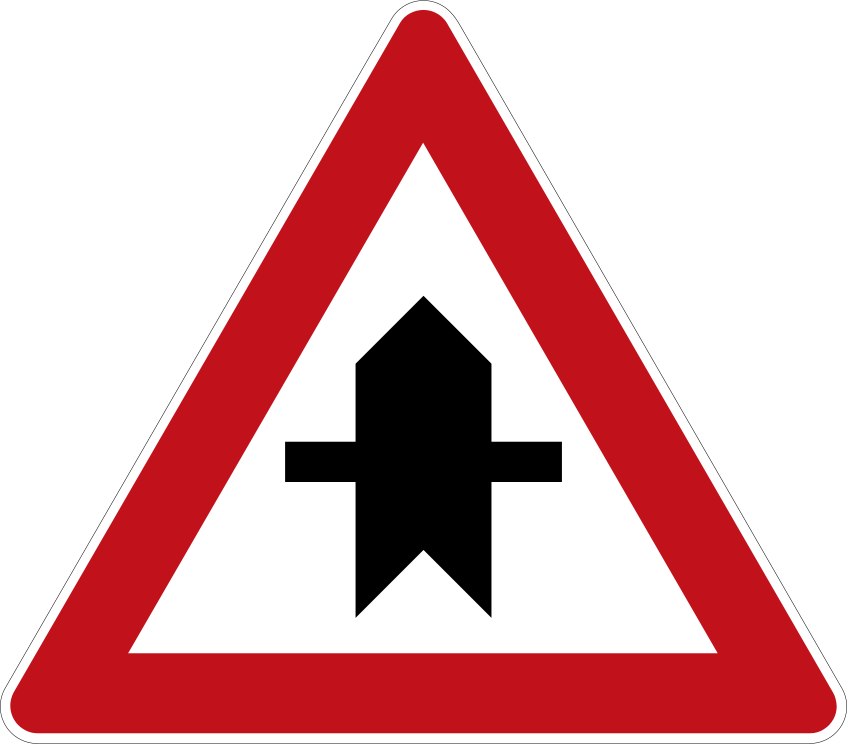
301 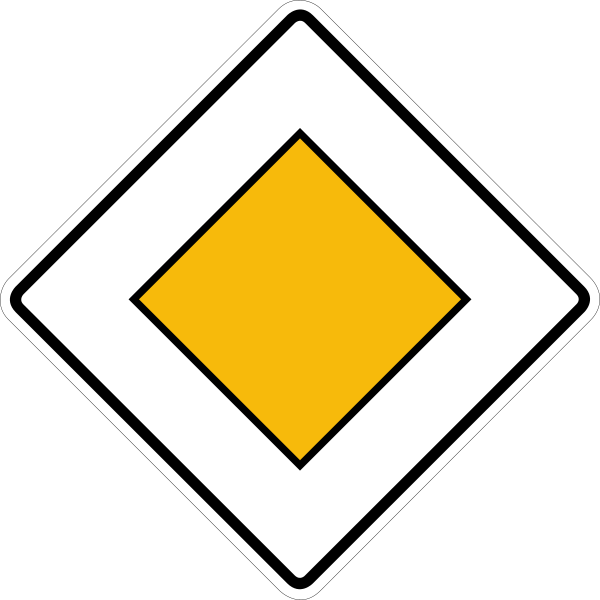
306 Field or forest track
A driver emerging from a field or forest track does not gain priority merely by approaching from the right.
§ 8 StVOExit, another part of the road or lowered kerb
A driver entering the carriageway from a property, pedestrian zone, traffic-calmed area, another part of the road or across a lowered kerb must rule out danger to other road users. This is not a normal right-before-left case.
§ 10 StVOStVO Anlage 3
Internal aisles within one car park
That sign determines the order here: blue waits at sign 205 while green uses the continuous aisle. Without an explicit priority rule, right before left generally does not apply to car-park aisles that lack a clear road character. Markings alone are not enough. Drive slowly, be ready to brake and communicate when in doubt.
Read German priority signs correctly
Some signs warn, some apply to one junction, and others mark a priority road across several junctions. That scope changes the answer.
Warning only
Work out the rule at the upcoming junction itself.

Junction with priority from the right
Warns that right before left applies ahead.
Scope & common mistake
Warns about the next junction
- Scope
- A warning sign for the upcoming hazard.
- Common mistake
- It does not grant priority; it only announces the default rule.
You wait
Give way – and come to a complete stop at the stop sign.
Give way
Let traffic on the priority route pass.
Scope & common mistake
For this junction
- Scope
- Placed immediately before the junction; it may be announced in advance.
- Common mistake
- A full stop is not always required, but clear visibility and readiness to wait are.
Stop. Give way
Come to a complete stop, then give way.
Scope & common mistake
Stop line → sight line
- Scope
- First stop completely at the stop line. If visibility is still blocked, edge forward slowly to the sight line and check priority again; without a stop line, stop where the other road can be seen.
- Common mistake
- A rolling stop is not enough.
You have priority
Once at the next junction or continuously on a priority road.
Priority at the next junction
You have priority at the next junction or intersection.
Scope & common mistake
At the next junction only
- Scope
- One junction only.
- Common mistake
- Do not treat it as a continuing priority-road sign.
Priority road
You are travelling on a designated priority road.
Scope & common mistake
Continues across junctions
- Scope
- Continues until “Give way” (205), “Stop” (206) or “End of priority road” (307) changes or ends it.
- Common mistake
- At a bending priority road, read the diagram and signal if you follow the bend.

Check again
The priority road ends; read the next rule afresh.
End of priority road
The route designated by “Priority road” (306) ends.
Scope & common mistake
The priority road ends
- Scope
- Assess the next junction again using lights, signs and the default rule.
- Common mistake
- This does not by itself mean right before left applies immediately.
Turning: who has priority?
Many theory-test mistakes happen after the junction priority has already been identified correctly. The missed rule belongs to the turn itself.
Blue wants to turn. The arrows show the direction of travel. The yellow dot marks where the paths cross.
Left-turning drivers wait for oncoming traffic
When turning left, let oncoming vehicles pass first. This still applies when you are on a priority road.
“Vorfahrt” and “Vorrang” are not identical
English often translates both concepts as “right of way”. German driving theory separates them, which makes complex scenes easier to solve.
Vorfahrt
German legal termThe order between vehicles at junctions and intersections.
Typical cases: right before left, “Give way” (205), “Stop” (206), “Priority” (301) and “Priority road” (306).
Vorrang
German legal termPriority in other meeting or movement conflicts.
Typical cases: oncoming traffic when turning left or vehicles at a narrow section.
Who goes first at a roundabout?
A circular road alone does not give circulating traffic priority. Compare these two situations.
“Give way” (205) + “Roundabout” (215)
When the roundabout sign is placed below a give-way sign, vehicles already circulating have priority.
Test your right-of-way knowledge
Apply the rules to two situations: oncoming traffic on a priority road and cycling traffic when turning right. Every answer gets an explanation.
Priority road with oncoming traffic
Both vehicles are on the priority road. You turn left; the red car continues straight.
Who moves first?
The six learning chapters and exercises above stay free.
Common questions about right of way in Germany
The key answers, with the relevant rules to read in full.
When does right before left apply in Germany?
Normally at junctions and intersections without special traffic control, unless a statutory exception such as emerging from a field or forest track applies.
§ 8 StVODoes right before left apply at a T-junction?
It can. A road continuing through the junction does not gain priority from its shape alone.
§ 8 StVOWho has priority at a German roundabout?
With the usual “Give way” (205) and “Roundabout” (215) sign pair, circulating traffic has priority. Without that pair, inspect the actual traffic control instead of assuming.

Should I signal when entering a roundabout in Germany?
May I turn left first because I am on the priority road?
Does right before left always apply in German car parks?
No. In publicly accessible car parks, the signs, markings and road-like character of the aisles matter. Ambiguous layouts call for slow, defensive and communicative driving.
§ 1 StVO§ 8 StVOBGH VI ZR 344/21